
Hemoglobin is measured as part of a complete blood count (CBC). A low result is a finding to explain, rather than a diagnosis of iron deficiency. Several causes can overlap, and the next step depends on how low the value is, how quickly it changed, and how you feel. Arrange a medical review of an unexplained low result, even if you feel well.
This educational article does not replace individual medical advice.
What Is Hemoglobin, and What Does It Do?
Hemoglobin is the iron-containing protein inside red blood cells that carries oxygen from your lungs to your tissues. A hemoglobin blood test measures its concentration in blood. Reports may abbreviate it as Hb or Hgb. Anemia means that hemoglobin is below the relevant threshold; identifying the reason requires more information.
Hb is different from hematocrit, the proportion of blood volume occupied by red cells, and ferritin, a protein whose blood concentration helps assess iron stores. These results answer different questions. You can have depleted iron stores before hemoglobin becomes low, or low hemoglobin for a reason unrelated to depleted iron stores. The NHLBI explanation of anemia testing describes how CBC measurements fit together.
Check the units before comparing reports: 1 g/dL = 10 g/L. A result of 12 g/dL and a result of 120 g/L express the same concentration. A change in the printed unit alone is not a change in your blood.
What Counts as Low Hemoglobin?
The WHO 2024 guideline, Table 2 gives the following anemia cutoffs. These are lower thresholds, not full hemoglobin normal ranges or targets for treatment.
| Population | Hb, g/dL | Hb, g/L |
|---|---|---|
| Nonpregnant women, ages 15–65 | <12.0 | <120 |
| Men, ages 15–65 | <13.0 | <130 |
| Pregnancy, first trimester | <11.0 | <110 |
| Pregnancy, second trimester | <10.5 | <105 |
| Pregnancy, third trimester | <11.0 | <110 |
Source: WHO, Guideline on haemoglobin cutoffs to define anaemia in individuals and populations. “<” means below the stated concentration.
Interpretation also considers age, pregnancy, altitude, smoking, and how the sample was collected and measured. The adult rows above specifically cover ages 15–65; they should not be presented as a complete table for every age group. Pregnancy changes plasma volume, which helps explain why trimester matters.
A laboratory's reference interval is the range printed on your own report. It may differ from a WHO cutoff because of the laboratory's methods and reference population. Neither a population cutoff nor the edge of a reference interval defines your personal “optimal” Hb. Use the report's context and your clinician's interpretation together.
7 Causes of Low Hemoglobin
Broadly, hemoglobin falls when the body loses red cells, makes too few, or destroys them too quickly. The following categories include both common and less common explanations. They are not a ranking of what is most likely for you.
1. Iron deficiency
Iron is needed to make hemoglobin. Stores can become depleted because intake does not meet needs, absorption is reduced, or iron is lost through bleeding. Pregnancy can increase requirements. Celiac disease and some gastrointestinal conditions can interfere with absorption.
Low ferritin can support iron deficiency, and red cells may become small with less hemoglobin per cell. But a normal cell size does not exclude early deficiency. Confirming the deficiency should prompt a discussion about why it developed, rather than simply replacing iron. The BSG guideline on iron deficiency anemia addresses both treatment and investigation of its cause.
2. Blood loss
Heavy menstrual bleeding, gastrointestinal bleeding, surgery, injury, and repeated blood donation can reduce red cells or iron stores. Slow gastrointestinal blood loss may not be obvious. A clinician may ask about stool changes, menstrual patterns, stomach symptoms, aspirin or anti-inflammatory medicines, and anticoagulants.
Blood loss and iron deficiency are overlapping categories: chronic bleeding can eventually deplete iron. Finding one does not end the investigation. Depending on age, symptoms, and history, unexplained iron deficiency anemia may require gastrointestinal evaluation. Do not stop prescribed medicines without advice.
3. Vitamin B12 or folate deficiency
These vitamins support normal red cell production. Deficiency may follow inadequate intake, poor absorption, or other medical conditions. B12 deficiency can also affect nerves, so tingling, numbness, or balance problems belong in the clinical history.
Red cells are often larger, but mixed deficiencies can obscure that pattern. Vitamin testing and the person's history matter more than assigning a diagnosis from MCV alone. Mayo Clinic's overview describes nutritional and other causes of anemia.
4. Chronic inflammation and chronic disease
Persistent inflammation can make stored iron less available for red cell production and interfere with production itself. Inflammatory disorders, infections, and some cancers can contribute. Ferritin can rise with inflammation, so an apparently normal or high result does not always rule out accompanying iron deficiency.
Clinicians interpret ferritin alongside the history and, when useful, transferrin saturation or inflammation markers. Having a chronic condition does not automatically explain every new low Hb result.
5. Chronic kidney disease
The kidneys produce erythropoietin, a hormone that signals the bone marrow to make red cells. Damaged kidneys may produce less of it. Iron deficiency and inflammation can coexist with kidney disease, making the explanation multifactorial.
Creatinine and estimated glomerular filtration rate (eGFR) help assess kidney function. Treatment is selected for the individual's kidney disease and anemia, rather than copied from a general iron regimen. See NIDDK: Anemia in Chronic Kidney Disease.
6. Hemolysis and inherited blood disorders
Hemolysis means red cells are destroyed faster than they can be replaced. It can be acquired or inherited. Inherited disorders such as sickle cell disease and thalassemia can affect red cell survival or hemoglobin production.
Family history, a blood smear, reticulocytes, and selected tests for red cell breakdown or hemoglobin variants may help distinguish these conditions. Small red cells do not automatically mean iron deficiency; thalassemia is one alternative explanation.
7. Bone marrow problems and other less common conditions
Bone marrow disorders can reduce blood cell production. Medicines, including some cancer treatments, can also affect the marrow. Abnormalities in white cells or platelets alongside low Hb may change which investigations are needed.
This category includes uncommon conditions and is not a reason to assume that one flagged result means cancer. Persistent unexplained anemia or concerning CBC findings may lead to hematology referral. A marrow test is a selected investigation, not a routine next step for everyone. The Merck Manual diagnostic overview explains this approach.
Symptoms of Low Hemoglobin
Possible symptoms include fatigue, weakness, reduced exercise tolerance, shortness of breath during activity, dizziness, headaches, palpitations, and paleness. Mild anemia may cause no symptoms. How quickly Hb falls and other heart or lung conditions can influence how someone feels; two people with similar results may feel very different.
These symptoms are nonspecific. Fatigue alone does not diagnose anemia, and feeling well does not make an unexplained low result irrelevant. Tell your clinician about onset, progression, bleeding, medication changes, and how symptoms affect ordinary activities. NHLBI lists typical anemia symptoms.
When to seek urgent medical help
Seek emergency care for severe breathing difficulty, chest pain, fainting with ongoing illness, or heavy bleeding. Vomiting blood with dizziness, feeling unwell, or black stools needs emergency assessment. Any vomiting of blood needs urgent medical advice, even if it stops. Use your local emergency service; do not wait to build a trend or repeat Hb. These signs can have causes other than anemia. See NHS guidance on breathing difficulty and vomiting blood.
Which Tests Help Explain Low Hemoglobin?
The first step is usually a review of the whole CBC and clinical history. MCV describes average red cell size; MCH describes hemoglobin per red cell; RDW describes variation in cell size. White cells and platelets add context. A reticulocyte count helps assess the marrow's response, and a blood smear can reveal cell features.
The table shows possible directions for investigation, not a checklist to order yourself. A clinician selects tests based on the initial findings.
| Possible explanation | Relevant context or selected tests |
|---|---|
| Iron deficiency or chronic blood loss | Ferritin, transferrin saturation when needed; menstrual, donation, and gastrointestinal history |
| B12 or folate deficiency | Vitamin levels, diet and absorption history, neurological symptoms |
| Inflammation or kidney disease | Clinical history, selected inflammation markers, creatinine/eGFR, iron studies |
| Hemolysis or inherited disorder | Reticulocytes, smear, selected breakdown markers or hemoglobin testing |
| Marrow disorder | Other blood cell counts, smear, specialist assessment when indicated |
Sources: Merck Manual: Evaluation of Anemia and the BSG guideline.
Low hemoglobin but normal iron? Serum iron is not the same measurement as iron stores. A normal serum iron result by itself does not settle whether iron deficiency is present. Ferritin is usually more informative about stores, with interpretation adjusted for inflammation; transferrin saturation may add context. Conversely, if deficiency is excluded, other causes of low Hb still need consideration.
What Does Research Say About Low Hemoglobin and Health?
The Global Burden of Disease 2021 analysis, published in The Lancet Haematology in 2023, estimated that 1.92 billion people had anemia in 2021. This was a modeled global estimate, not a cohort of that many people individually examined. Dietary iron deficiency was a major contributor, alongside other causes. The study describes population burden; it cannot diagnose the cause of one person's result.
Ahmad and colleagues' 2026 prospective UK Biobank study examined baseline hemoglobin and later mortality. Hb was available for 477,876 participants, with a median follow-up of 13.6 years. The relationship was U-shaped: lower and higher concentrations were associated with higher mortality than intermediate concentrations.
The authors described their findings as hypothesis-generating. The study used one baseline Hb measurement, and its population was predominantly White. It does not establish a new target Hb, show that raising a person's value improves survival, or test whether repeated tracking prevents disease. Health conditions that affect both hemoglobin and mortality can contribute to an observed relationship.
“Associated with” means that findings occurred together in the analyzed data after the study's adjustments. It does not prove cause and effect. Group-level risk estimates are not a personal prognosis. The practical reason to investigate low hemoglobin is to identify a potentially treatable cause and assess symptoms, rather than to aim for a number taken from a mortality curve.
My Hemoglobin Is Still Normal, but It's Dropping — Does That Matter?
A consistent decline can add useful context, even before a result crosses a threshold. It is a reason to review the history, especially with symptoms or bleeding, rather than proof of a particular illness.
Fictional example: a nonpregnant woman has Hb values of 14.2 → 13.6 → 12.9 g/dL on the dates shown below. All remain above the WHO cutoff for nonpregnant women ages 15–65. The last value would be below the corresponding cutoff for men. This illustrates why a chart needs clinical context; it is not a diagnostic rule.
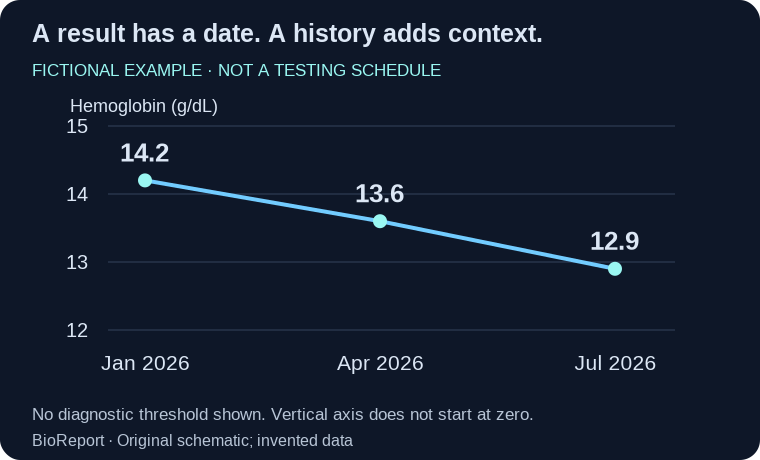
Original BioReport schematic, freely reusable with attribution. Invented data, not study participants or a recommended testing schedule. The vertical axis runs from 12 to 15 g/dL and does not start at zero. Points are joined only to make the sequence visible.
Dayimu and colleagues (2019) studied 11,431 adults in China, with 3–9 Hb measurements, in a cohort selected at ages 20–50. A decreasing trajectory was associated with stroke in men; the result in women was not statistically conclusive. This observational study does not show that frequent testing prevents stroke or that this fictional pattern predicts a reader's risk.
Small fluctuations may reflect biological variation, hydration, sampling, or laboratory methods. Bring the original reports and symptom history to a clinician before treating a visual slope as a meaningful medical change. MedlinePlus explains why reference ranges and laboratory methods matter.
How Often Should You Check Hemoglobin?
Healthy adults without symptoms: the sources discussed here do not establish one evidence-based retesting interval for everyone. A routine annual or quarterly CBC is not a conclusion of the trajectory research. Decide whether testing is useful with a clinician, considering previous results, bleeding, pregnancy, diet, medicines, and other risk factors.
During treatment for confirmed iron deficiency anemia: the BSG guideline recommends monitoring the Hb response within the first 4 weeks of oral iron treatment. This is monitoring of an established condition. A lack of improvement may lead to reassessment of ongoing blood loss, absorption, treatment tolerance, or the diagnosis.
After correction: for people with unexplained iron deficiency anemia who have had a negative investigation, no other symptoms, and a sustained response to iron replacement, BSG describes periodic blood counts and suggests checks at perhaps 3, 6, 12, and 24 months. This is a contextual suggestion, not a universal schedule or a reason to postpone review of returning symptoms.
Other chronic conditions: kidney disease, inflammatory disease, and specialist treatments have their own monitoring plans. For example, KDIGO's 2026 anemia guideline concerns people with chronic kidney disease. Those recommendations should not be transferred to healthy adults.
Ask what the repeat test is intended to answer and what should trigger earlier contact. New or worsening symptoms can change the plan.
How Is Low Hemoglobin Treated?
Treatment depends on the cause, severity, and symptoms. Confirmed iron deficiency may need oral or intravenous iron and investigation of the source of deficiency. Blood loss may require treatment of the bleeding source. B12 or folate deficiency needs appropriate replacement, while inflammation, kidney disease, hemolysis, and marrow disorders require condition-specific care.
There is no single food, supplement, or exercise routine that treats every cause of low Hb. A balanced diet supports blood cell production, but dietary changes alone may not address established anemia or ongoing bleeding. Do not start high-dose iron simply because Hb is low: iron can cause side effects, and taking it without a confirmed need can delay the right investigation. NHLBI's treatment overview explains why the underlying cause determines care.
Severe or symptomatic anemia sometimes needs urgent treatment, including transfusion in selected circumstances. This decision is made clinically, rather than from a universal internet threshold. Follow the prescribed plan and report poor tolerance or worsening symptoms; changing treatment yourself can make follow-up harder to interpret.
How to Keep Track of Hemoglobin Results Over Time
For each result, keep the collection date, Hb value, unit, laboratory, printed reference interval, and original report. Add relevant context such as pregnancy, recent illness, bleeding, and the start of prescribed treatment. Convert compatible units carefully and verify extracted values against the PDF.
If you are deciding how to store this information, our comparison of spreadsheets, patient portals, and blood-test trackers explains the practical tradeoffs.
BioReport supports lab-report PDF import, LOINC-based biomarker normalization, and a dated history with charts, as described in its guide to comparing results across labs and dates. Source context still matters: software cannot make every pair of tests clinically interchangeable. BioReport is a tool for organizing records and preparing questions, not diagnosing anemia.
Frequently Asked Questions
Can low hemoglobin be temporary?
Yes. It can improve when a temporary cause resolves or effective treatment begins. A single low value still needs interpretation; a repeat result should answer a clinical question rather than simply dismiss the first one.
Is low hemoglobin always caused by iron deficiency?
No. Blood loss, vitamin deficiencies, inflammation, kidney disease, hemolysis, and other conditions can contribute. A normal serum iron result alone does not exclude iron deficiency, either.
Can hemoglobin be low without symptoms?
Yes, especially when anemia is mild or develops slowly. Absence of fatigue or breathlessness does not explain the cause, so discuss an unexplained low value with a clinician.
What is the difference between hemoglobin and ferritin?
Hemoglobin carries oxygen in red cells; ferritin helps assess iron stores. Iron stores can be low before Hb falls, while inflammation can complicate ferritin interpretation. The two tests are not interchangeable.
How long does hemoglobin take to improve?
It depends on the diagnosis, treatment, ongoing losses, and absorption. For oral iron treatment of confirmed iron deficiency anemia, BSG recommends checking the Hb response within the first 4 weeks; that is a monitoring point, not a promise of full recovery by then.
Should I worry if my hemoglobin is dropping but still normal?
Bring a sustained decline to your clinician, especially with symptoms or bleeding. A small change may have non-disease explanations. A trend by itself cannot diagnose a condition or predict your personal risk.
How often should I repeat a hemoglobin blood test?
Use a plan based on the reason for testing. Treatment monitoring and follow-up of established anemia differ from testing a healthy person without symptoms. Seek advice sooner if symptoms develop or worsen.
What to Do Next
Start with the cause: low Hb is a finding, and iron deficiency is only one possible explanation. Review the whole CBC, symptoms, medical history, and laboratory context with a qualified clinician. Seek urgent care for the warning signs above.
Keep previous results and the original reports together so changes are easier to discuss. A useful history supports a medical conversation without turning a chart into a diagnosis. BioReport can help organize those records for your next appointment.
Sources and Further Reading
- WHO (2024): Guideline on haemoglobin cutoffs, including Table 2.
- GBD 2021 Anaemia Collaborators (2023), The Lancet Haematology. PubMed record.
- Ahmad et al. (2026), Annals of Internal Medicine. DOI: 10.7326/ANNALS-26-00057. The account above is limited to the publicly available abstract; full text was not accessible during preparation.
- Dayimu et al. (2019), BMC Public Health, full text.
- Snook et al. (2021): BSG guidelines for iron deficiency anemia in adults. DOI: 10.1136/gutjnl-2021-325210. Also available as a full-text PDF from BSG.
- NHLBI: Symptoms, diagnosis, and treatment.
- NIDDK: Anemia in Chronic Kidney Disease; KDIGO: 2026 anemia guideline.
- Merck Manual: Evaluation of Anemia; Mayo Clinic: Anemia.
- NHS: Shortness of breath and vomiting blood; MedlinePlus: Understanding lab results.